
The Trinity County Weekly Arrest Log
Trinity County publishes no rolling weekly arrest log, 72-hour list, or online police blotter. The Sheriff’s official page offers contacts plus a VINE link. Meanwhile, the 2026 Custudy Manual describes a daily log kept at the correctional facility. Selected log information may be released when someone asks. That is a request-based record. It is not a public feed. A multi-day request can cover arrest and booking times, location, circumstances, and agency. It can also include charges, warrants or holds, bail, release, current location, and court dates. What gets disclosed still depends on law and safety. Investigative limits apply too.
Build a Trinity Multi-Day Record
There is no blotter interface to scroll. Build a Trinity multi-day record the practical way. Start with a precise time range. The Sheriff Records Lobby is the main local access point for arrest and booking material.
- Set the start and end dates, including the prior evening if booking may have crossed midnight.
- Identify the arresting agency and location when known.
- Ask Records for the releasable daily-log fields within that range.
- Check VINE for custody status and the court for any filed case.
- Use the Daily Arrest Report when the question concerns only today or last night.
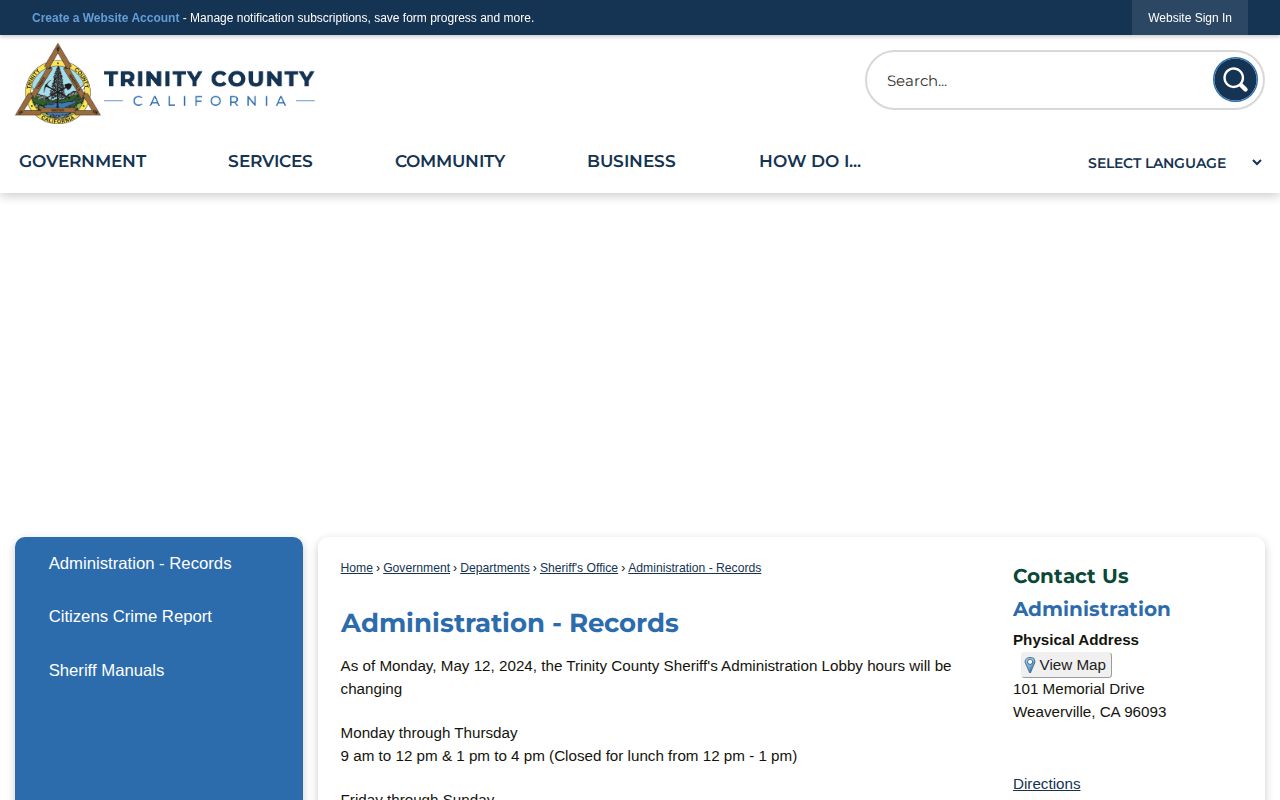
Find the Records Lobby at 101 Memorial Drive in Weaverville. Call 530-623-2611. Published hours run Monday through Thursday, 9:00 a.m. to noon and 1:00 p.m. to 4:00 p.m. The lobby stays closed Friday through Sunday and on legal holidays.
Trinity Arrest Log Fields
The daily-log policy gives the clearest field inventory available. A broader custody file exists too, but it holds confidential medical, classification, cell-assignment, grievance, communication, and property material. Keep a public request narrow.
| Field | Use |
|---|---|
| Name, age, description, occupation | Match the person carefully |
| Arrest and booking time | Separate the event from jail intake |
| Place and factual circumstances | Identify the incident and location |
| Charges, warrants, holds, bail | Read as booking-stage charges and custody bases |
| Release or current location | Status when the record was prepared |
| Court date and agency | Route the next official check |
The county has no official online photo policy or gallery. A booking photograph can sit in the custody file anyway. Public display is a separate question from what exists in the record.
Weekend Trinity Arrest Delays
The jail runs around the clock. Records staff do not. Public counter hours end Thursday afternoon. Weekend arrests keep happening while nobody is there to answer requests. No official statement promises a Monday data release or any weekend posting schedule. A burst of news or responses after the weekend reflects access patterns. It is not a sudden wave of arrests.
The Trinity County recent-arrests hub splits jail custody, requested booking data, court filings, and secondary reports into separate lanes. Note the date and time of each check. Custody status can change mid-search across several days.
Older Trinity Arrest Records
The county publishes no online archive cutoff. Older Sheriff records follow standard retention schedules. Retention alone does not make the whole custody file public. Ask the Sheriff Records Lobby with exact dates in hand. Request whichever daily-log fields remain available. The official records page serves as the fallback for older Trinity County arrest material. Expect no posted fee table or guaranteed response time.
Ask about current fees and format before sending payment.
Trinity Arrest News Archives
News outlets fill in what the jail does not. The Trinity Journal, the Crime Voice Weaverville tag, and Kym Kemp's Trinity County tag each run occasional pieces on Trinity County arrests. None of them posts a complete booking roster. Treat them as story context, not a record. A Weaverville dateline can point to the jail or courthouse rather than where the arrest happened. The Crime Voice Weaverville feed works best as a secondary source.
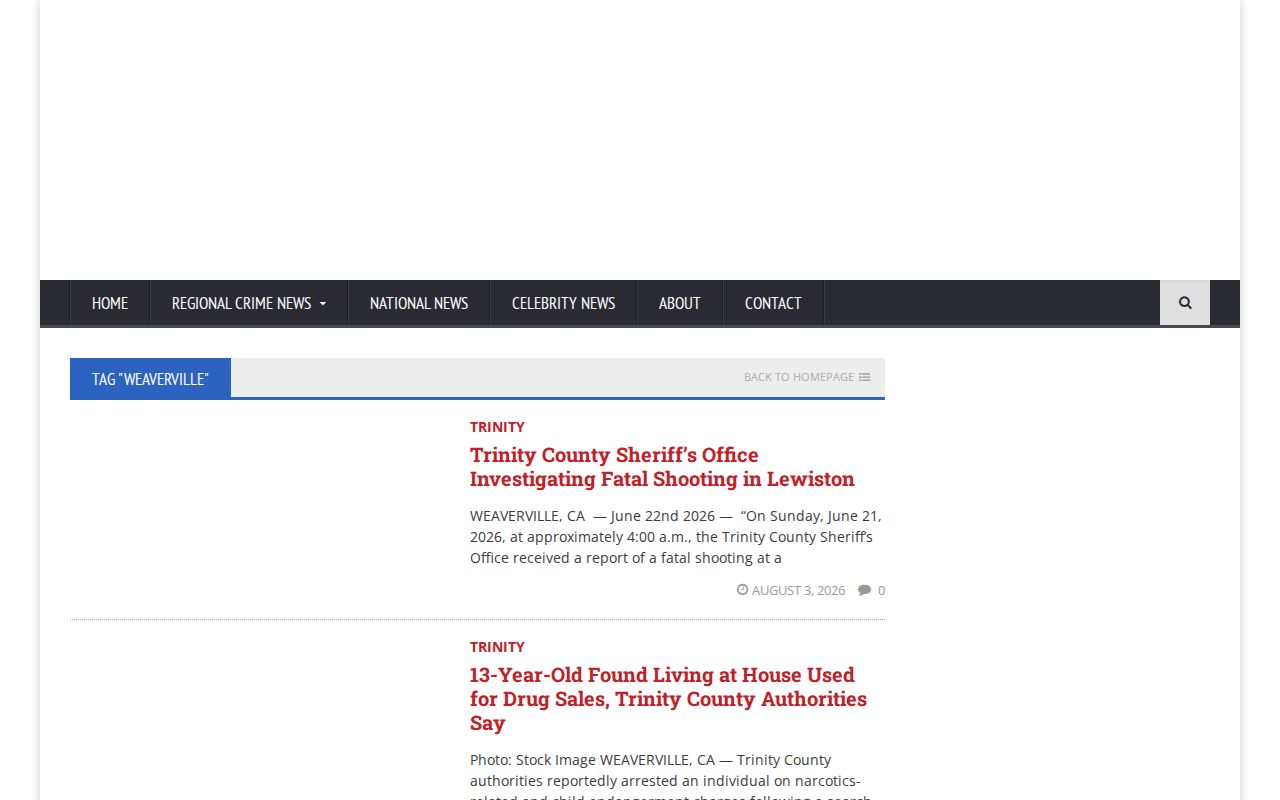
Cross-check any news item with Sheriff Records. The final court file settles the rest. Commercial sites like Mugshots.com and JailExchange often run stale. RecentlyBooked leaves Trinity County out of its California index, and neither Arrests.org nor Mugshots.zone carries a local Trinity section, so a missing entry never proves an arrest did not occur. The Kym Kemp Trinity County archive shows how regional outlets jump on major events instead of logging every single booking.
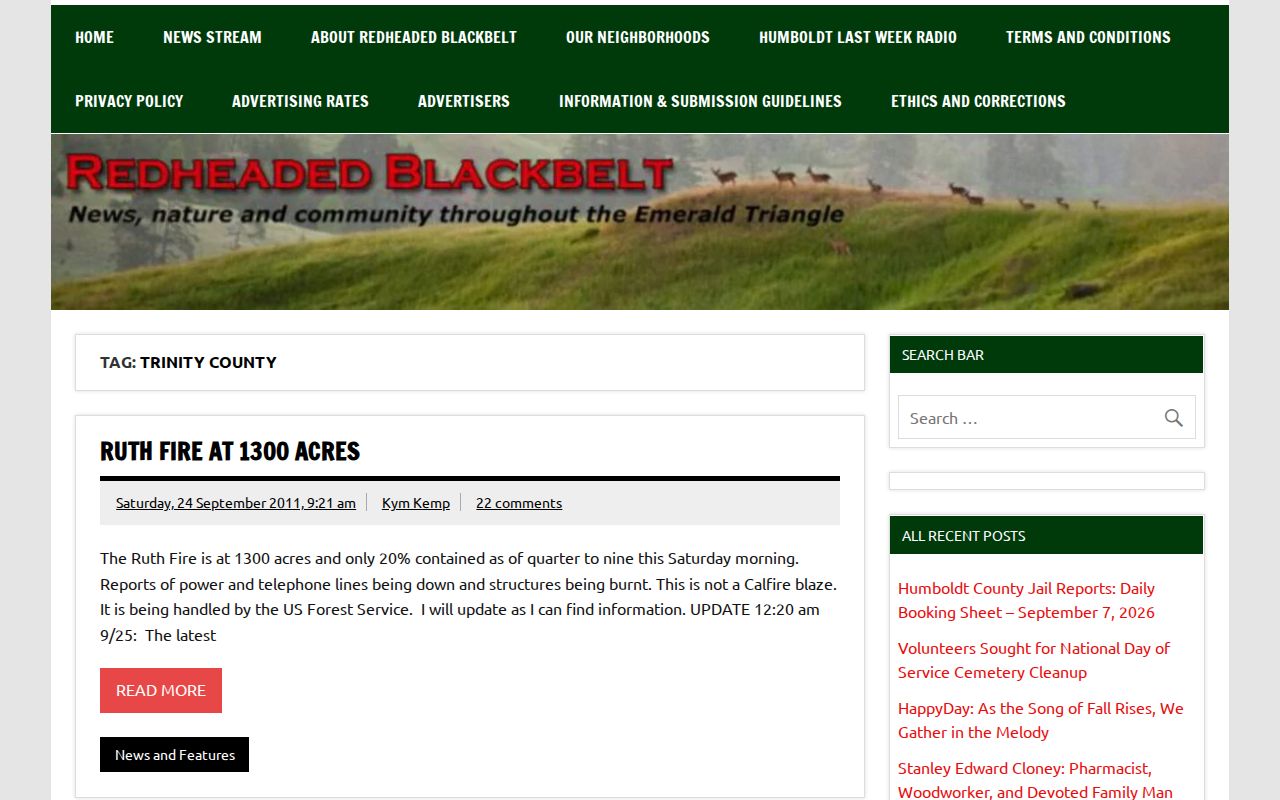
The Kym Kemp Trinity County archive shows how event-driven regional coverage works. Dated stories there add context. Treat the archive as a supplement. It is not an official arrest register.
Agency Lines Shape Trinity Logs
Trinity County has no incorporated cities and no municipal police blotters. Reports can originate with the Sheriff, California Highway Patrol, U.S. Forest Service, CalFIRE, or the Department of Fish and Wildlife, according to the county FAQ. So preserve the arresting-agency field in any multi-day search. It explains a real split. One event lands in a Sheriff record. Another may surface only in a highway-patrol story or a court file.
Geography distorts searches too. Weaverville hosts the Records Lobby, the jail, and the main courthouse. A page tagged "Weaverville" might mean the arrest scene. It could also mark the booking destination or the courtroom where the case will be heard. Or it may just name the county seat. Keep those three locations in separate notes. For rural spots like Hayfork, Lewiston, or Post Mountain, a name alone is thin. Search by date and agency alongside the community name.
Trinity Arrests Meet Court Records
A week of arrests is only the first chapter of a case. The District Attorney reads each agency report and can decline to file it. When charges are filed, they may not match the booking charges. Charges also get amended, reduced, or dropped. That can happen as a case moves. The Trinity Superior Court criminal division lays out arraignment and the steps that follow. Its online services include calendars. The court offers no public criminal-case name search, though. For inspection, copies, case numbers, or dispositions, call the clerk at 530-623-1208.
Dates in a Trinity County arrest log each tell you something different. Arrest time marks the reported taking into custody. Booking time marks processing at the facility. A court date marks a later proceeding. Release time records a change in custody. Pair any multi-day review with the court's disposition if a case was filed.
Request a Trinity Date Range
A focused written request is the closest thing to an archive search. Start with a start date and an end date. Add the person's full name, plus any booking or incident number. Name the arresting agency or location too. Say exactly which item you want. It might be the daily-log entry, the booking sheet, release information, or another defined record. Ask for segregable portions, the parts that can be split from protected material. Request a fee estimate and the current delivery options before any payment goes out.
One caution about forms. The county's published public-records form sits with Planning materials. It is not confirmed as the Sheriff's. Treat its timing and copying terms as a county example only. The Sheriff's own pages list no booking-record form, fixed fee, or guaranteed turnaround. Call Records first to confirm the preferred method. The general Sheriff contact form can open an inquiry. It is not labeled a booking-record portal. Keep sensitive case details out of a web message. Staff can steer you to a better channel.
Trinity Arrest Trends Need Context
A weekly list and a statistical trend answer different questions. The California Department of Justice OpenJustice data portal and Board of State and Community Corrections reference material can place Trinity County arrest or jail measures in a longer frame. Those datasets are not person-level booking logs. Their reporting periods do not create a live seven-day window. Use them for aggregate patterns instead of trying to infer that a named person was arrested.
Small counts swing hard in a rural county. One operation, a storm, a court calendar, or a cluster of agency reports can reshape a short stretch without showing a lasting rise. News volume creates its own false signal. Editors pick some incidents and skip others. Compare like periods. Read the dataset definitions closely. Check whether a measure covers arrests, bookings, jail population, filed cases, or convictions. Those categories cannot be swapped for one another.
Verify Trinity Blotter Stories
Verify a blotter story from the event details, not the headline. Note the date reported and the date of arrest. Add the named agency, the alleged charge, and the location. Then ask Sheriff Records whether a matching releasable log entry exists. The story may say the person was booked. Weigh that claim against custody or release information. If prosecutors filed a case, the court clerk can supply the charging document and the later disposition. Any correction should stay attached to the original note.
Commercial pages carry their own traps. They may keep an old booking photo or merge separate incidents into one entry. Their database counts are not the Trinity County Correctional Facility population. Treat a third-party "recent" label as undefined unless the publisher states the dates and source. The official county record comes first. Local journalism adds selective context. A commercial index sits last as the weakest check.